Skip to content
Angkor Grand Circuit Route
See six major temples in the right order, skip the usual pacing mistakes, and end the day where the late light actually pays off.
Stop by stop timing, temple sequence, lunch reset at Srah Srang, ticket facts, entry prep, and the one route order I would hand to a traveler who wants one full day done right.
Angkor Grand Circuit Route works best when the day is laid out in travel order, not temple fame order. If you start strong at Preah Khan, cross the water to Neak Pean before the heat bites, pause at Srah Srang for lunch, then leave Pre Rup for late afternoon, the day feels coherent instead of patched together.
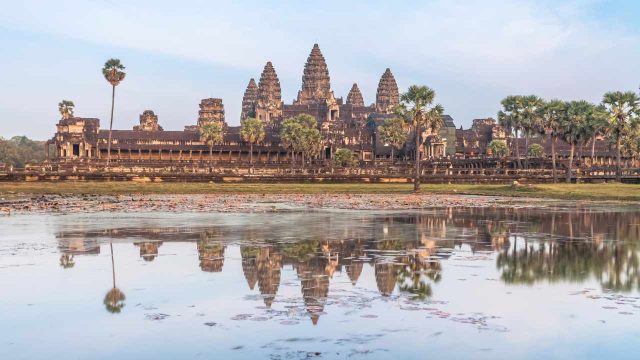
The Angkor Grand Circuit Route is a full-day outer loop through six temples: Preah Khan, Neak Pean, Srah Srang, Ta Som, East Mebon, and Pre Rup. The order matters. It puts the longest early walk first, places the water stop before lunch, and saves the steep climb at Pre Rup for the warm light later in the day. If you are sorting entry prep first, Cambodia e-Arrival is free and must be submitted within 7 days before arrival, and the official tourist eVisa is listed at USD 30, single entry, with3 business daysprocessing. For park entry, the current Angkor pass rates shown on the official Cambodia eVisa site areUSD 37 for 1 day,USD 62 for 3 days, andUSD 72 for 7 days. If you want the full day arranged with hotel pickup, guide, transport, and park pass included, this one-day private temple day is the page to keep open.
Quick Take
- Angkor Grand Circuit Route in travel order is: Preah Khan, Neak Pean, Srah Srang, Ta Som, East Mebon, Pre Rup
- Pickup is around8:15 amfor an8:30 amstart
- Preah Khan gets the longest stop at90 minutes
- Srah Srang is the lunch break
- Pre Rup is last, with about60 minuteson site
- e-Arrival is still required even if you already hold a visa
What is the Angkor Grand Circuit Route in travel order?
It is the outer Angkor loop done as a one-day sequence that starts with Preah Khan and ends at Pre Rup.
That sounds basic, but this is where many travelers lose the day. They pick temples by fame, not by flow. When I map temple days for people, I want the route to do some of the work on its own. The Angkor Grand Circuit Route is one of the few Angkor days where the order feels almost self-correcting if you follow it properly.
The route used on the Southeast Asia Journeys one-day page runs like this: Preah Khan, Neak Pean, Srah Srang, Ta Som, East Mebon, then Pre Rup. That gives you one big monastery first, one water temple second, one quiet lunch reset in the middle, and one steep temple-mountain last. It is a cleaner rhythm than trying to wedge Pre Rup into midday.
There is also a plain reason travelers search this route by order. These temples do not hit the same way at the same hour. Preah Khan rewards slow walking early. Neak Pean is better before the boardwalk gets hotter. Ta Som feels nicer once the lunch wave passes. Pre Rup is where late light matters most.

Why does the Angkor Grand Circuit Route work so well in one day?
The order spaces out walking, heat, and visual fatigue better than a random temple list.
Angkor days go wrong when every stop asks the same thing from you. Too many stairs in a row. Too many long galleries in a row. Too much exposed stone in the noon sun. The Angkor Grand Circuit Route avoids that trap when you keep the route in order.
Start at Preah Khan, where the standard stop is about90 minutes. This is the longest walk of the day, and it earns it. The site page describes it as a 12th-century Buddhist monastery built by King Jayavarman VII and spread acrossnearly 140 acres. APSARA also dates the temple to the late 12th century, with the main divinity dedicated in1191. On the ground, that means long stone galleries, broken corners, roots, shade, sudden openings, then another corridor again. It wakes your eye up early.
Next comes Neak Pean, usually given60 minutes. The internal route page calls it a small island temple ringed by four healing pools and linked by a long wooden walkway. APSARA places it at the center of the Northern Baray, built under Jayavarman VII. After the stone maze of Preah Khan, that change in mood matters. The water opens the day up.
Then you stop at Srah Srang for lunch. This is not filler. The site describes it as the 10th-century Royal Bath, later reworked around1200 AD. APSARA also notes a man-made lake of about700 meterseast of Banteay Kdei. By this point, sitting near the water with food and a cold drink is not a luxury. It resets your legs and your patience.
After lunch, the route narrows again. Ta Som gets about60 minutes. APSARA describes it as a modest temple built under Jayavarman VII, ringed by concentric moats, with faces on the east gate. The tour page adds the part most travelers know from photos: the fig-tree-strangled gate. This is one of those stops that feels calmer in real life than it looks online. You hear leaves, footsteps, a few voices, then the camera clicks start.
After that, East Mebon is another60-minutestop. The route page says it was built on an island and is known for life-sized guardian elephants. APSARA confirms that it originally stood on an island, and another APSARA page notes elephant sculptures facing the four directions. I like East Mebon in this late part of the day because it feels spare. Less tangled. More open sky.
Then comes the finish that makes the route stick in your head. Pre Rup is the last temple, with about60 minutesthere and about30 minutesback to town after. APSARA dates it to the 10th century, and another APSARA listing says it was consecrated in961and is best seen toward sunset. That tracks with what many travelers feel on site. The stone warms up, the stairs feel more dramatic, and the flat plain around you looks wider than it did on arrival.
What should you know before booking the Angkor Grand Circuit Route?
Sort your entry paperwork, dress for temple rules, and be honest about the walking.
The Angkor Grand Circuit Route is easy to enjoy when the admin side is done first. It is a slog when you forget it. Start with Cambodia entry. The official e-Arrival card is free, it is not a visa, all travelers must submit it, and submission opens within7 daysbefore arrival. The same site says you should keep the QR code after submission.
If you need a visa, the official tourist Visa T isUSD 30, single entry, valid for3 months, gives a1 monthstay, and is listed with3 business daysprocessing. The official business Visa E is USD 35with the same single-entry, 3-month, 1-month-stay structure. The site also says Siem Reap Angkor International Airport accepts eVisa entry.
Then sort the park pass. The official Cambodia eVisa site lists Angkor ticket rates atUSD 37for 1 day,USD 62for 3 days, andUSD 72for 7 days, with ticket office hours of5:00 am to 5:30 pm. If you book the one-day route on the tour page, the page states that the Angkor Archaeological Park pass is included. That removes one extra errand from the morning.
Temple clothing still matters. The page says shoulders must be covered and pants or skirts must fall below the knee. Ignore that, and a gate check can stop your day cold. The same page also says the route involves moderate walking on uneven ground, while Pre Rup has steep stairs to the summit. That is the tradeoff. You are not doing a sprint, but you are not floating through it either.
One more point. This route is not built for wheelchairs, and the site says so plainly in its accessibility note. If you are traveling with small kids, the page also says infant car seats are available on request and the tour is open to ages0 to 99. That is the kind of detail families need before they land in Siem Reap, not after.
Should you book it on your own or use the Angkor Grand Circuit Route page?
If you want less friction on the day, use the page that already packages the route, timing, guide, and pickup.
You can do this route on your own. Plenty of travelers do. Still, the drag points are obvious. You need to line up timing, temple order, transport, lunch pause, and entry handling, then keep the day moving when the heat starts to flatten your mood. That is why I would keep the Angkor Grand Circuit Tour page open while you plan.
The page says hotel pickup is around8:15 amfor an8:30 amdeparture, with a licensed English-speaking guide, private transport, and hotel drop-off in Siem Reap city center. It also states that your guide confirms the booking with hotel staff on arrival. Small detail. Big relief when you are half awake in a hotel lobby.
If you want to compare the day with the wider company style, the main site says it has been crafting Cambodia trips since2003. That is enough for me to take the page seriously, then judge it on the route itself. And the route is solid. No wasted zigzags. No forced sunrise stunt. No messy finish.
If this article is answering the question you came with, the next click is easy. Go from this guide to the Angkor Grand Circuit Tour page, check the route against your travel dates, then keep the main site handy if you want more Siem Reap planning after the temple day.
What should you do next?
Use this route as written, sort the entry admin first, and leave room to linger at the temples that hold you.
I like the Angkor Grand Circuit Route because it feels like a day with shape. It starts with stone corridors, opens over water, settles at lunch, narrows again under trees, and ends high above the plain. When a temple day lands well, you do not come back talking about logistics. You come back talking about the sound inside Preah Khan, the still water at Neak Pean, the elephant corners at East Mebon, and the last climb at Pre Rup.
If I were handing this plan to a friend, I would say this. Use the Angkor Grand Circuit Route in this order. Submit your e-Arrival, sort your visa if you need one, check the current pass rates, then move from reading to booking. For the arranged one-day option, go to the tour page. If you want to talk to the team first, use the contact page and ask for your date.