Skip to content
Angkor in the Rainy Season
Angkor in the Rainy Season: Ultimate 2026 and 2027 Guide to Quieter Temples, Fewer Crowd Mistakes
Rain running down the face of a stone naga, a moat that has turned into a lake, and a corridor at Ta Prohm where the only sound is water hitting leaves. Angkor in the Rainy Season is not the trip on the postcard, and for plenty of travelers it is the one worth choosing.
Angkor in the Rainy Season runs from roughly May to October, and it reshapes the trip instead of closing it. You get greener jungle, moats that are actually full, softer light and far thinner crowds at the mid tier temples. Showers land mostly between late morning and mid afternoon and usually pass inside an hour, so an early start plus a real midday break still covers the main circuit. The pass price, the 5:00 AM gate opening and the 6:30 PM closing time stay the same all year round, which makes the wet months the cheapest stretch to visit. Bring grip soled shoes, a light rain jacket and a dry bag, and treat sunrise as a gamble rather than a plan.
What Shifts in the Wet Months
- Crowds move, they do not vanish. Angkor Wat at sunrise and Bayon at mid morning stay busy. Preah Khan, Ta Som and Banteay Kdei go quiet.
- Water returns. The moat around Angkor Wat fills, and the reflection pools near the north causeway hold water instead of cracked mud.
- Light flattens. Cloud cover removes the hard noon glare that blows out photos from December to April.
- The ground turns slick. Laterite paths and temple steps get greasy, so pace matters more than distance.
- Time on site stays about the same. Budget two to three hours inside the archaeological area for a comfortable run at the principal temples, or six to eight hours if you are working through the Small Circuit and the long circuit in one push.
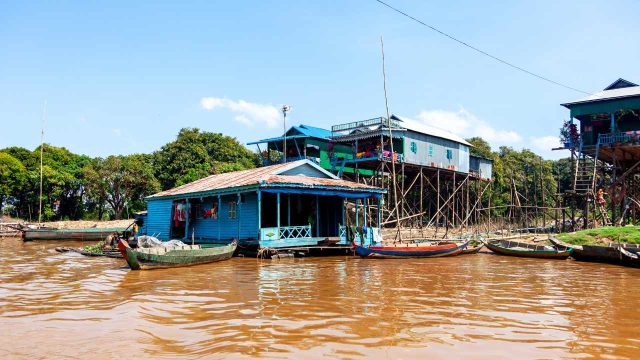
- The lake gives you a bonus. High water is exactly when the floating villages on the Tonle Sap look their best.

Why Angkor in the Rainy Season Feels Different from Postcards
The postcard shot is a dry moat, a pink sky and a tower mirrored in still water. In July that photo does not exist. What you get instead is a sky the color of wet concrete, a moat that has climbed its banks, and towers that read almost black against it. UNESCO describes Angkor as a site of about 400 square kilometres holding temples alongside basins, dykes, reservoirs and canals, and it is the water works that wake up first. These ruins were never only temples. They were a machine for moving water, and in the wet months you can watch it run.
Everything gets louder and softer at once. Louder, because water is moving off every lintel and through every drainage channel. Softer, because the stone loses its shine. Sandstone that stings your eyes at noon in February turns a dark grey green in August, and carvings on a shaded wall suddenly look as crisp as they did when they were cut.
The monsoon arrives in bursts, not as a grey wall
Two numbers tell the whole story. Siem Reap collects about 1,470 mm of rain a year, September alone averages 286 mm across roughly 18 wet days, and January sees about 9.8 mm on a single day. Rain is packed into a short window of the day rather than spread evenly across it.
So here is the honest version. You will get wet at least once. You will also get long dry stretches around those showers, often with softer light than the dry season hands you.
Crowd Patterns Shift: Where It Gets Quiet and Where It Does Not
Fewer people travel in the wet months, and it shows in the official numbers. Angkor Enterprise recorded 510,528 international visitors in the first nine months of 2025, a 27.61 percent fall from the year before, while September ticket revenue rose 3.1 percent to $1.69 million.
That split is the thing to understand. The park as a whole is emptier, but the famous stops stay famous.
Where the crowds still land
Angkor Wat at sunrise. Bayon from about 9:00 AM to 11:00 AM. Ta Prohm between 9:00 AM and midday, until the coach groups thin out around lunchtime. Those three windows are the ones to plan around rather than fight.
Where it goes quiet after lunch
Preah Khan, Ta Som, Neak Pean and Banteay Kdei sit on the long circuit and thin out fast once the morning groups roll on. On a wet Tuesday in August you can walk the long axis of Preah Khan and pass two other people.

Water Levels Rise: Moats, Pools and Reflection Shots at Angkor Wat
The moat around Angkor Wat runs roughly 190 metres wide with a perimeter of more than 5 km, and the temple sits on 162.6 hectares inside it. In the dry months the pool behind the north causeway shrinks to a pan of cracked mud. From July it holds water again, and the whole west face of the temple picks up a second skin of reflection.
The tradeoff nobody mentions: a wet season reflection pool is not the mirror in the brochures. The water is often brown with silt, wind pushes ripples across it, and you may wait twenty minutes for one unbroken frame. Photographers who accept that go home with something moodier than the standard shot.
Afternoon Showers Force a New Daily Route for Angkor in the Rainy Season
The official gate hours do not move with the weather. Angkor Enterprise lists entry at 5:00 AM and closing at 6:30 PM all year, for the same pass that covers more than 50 accessible temples. That single detail is the most useful planning fact of the season.
The route that works
Start between 5:30 AM and 6:00 AM while the air is still dry and cool, and put Angkor Wat or the nearest small temples first. Then stop. Storms are most likely between 11:30 AM and 2:00 PM, so give that window to a long lunch, a nap or the Angkor National Museum. Head back out around 2:30 PM for Ta Prohm and Bayon in the late light, when the stone is wet and the sky is doing something.
A sample wet season day
- 5:30 AM gate and sunrise at Angkor Wat
- 7:30 AM Bayon and the terraces of Angkor Thom
- 10:00 AM Ta Prohm before the coaches arrive
- 11:45 AM back to town for lunch and a rest
- 2:45 PM Ta Som or Preah Khan on the quiet circuit
- 5:15 PM Phnom Bakheng or a last stop near the moat
Why one long circuit beats two short days
Combining nearby temples on the Small Circuit saves more time than making separate long distance trips on two different days. You spend less time sitting in a tuk tuk in heavy rain and more time under cover, and you avoid paying for the same stretch of road twice.
The wet season bonus on the water
This is also when the Tonle Sap swells. The stilted houses at Kampong Khleang floating village stand over open water instead of mud, and the boat channels open up. Rain is the reason the lake works, not an obstacle to it. A Tonle Sap day trip fits neatly into the rainy months for exactly this reason.

Stone Steps Get Slippery: Footwear, Pace and Safety Changes
Khmer builders used laterite for foundations and sandstone for the show pieces. Laterite soaks up water like a sponge, and wet sandstone is slicker than wet bathroom tile.
The shoes question
Flat rubber soles are the worst choice you can make. Trail shoes or any pair with real tread bite into wet stone, and they dry overnight. Flip flops send people sliding on the upper levels of Angkor Wat and on the steep wooden stairways at Ta Keo.
The pace question
Shorten your stride on descents, hold the handrail, and take the wooden stairs where the original stone ones are also standing. It is fine to skip a wet climb altogether. No view over Angkor Thom is worth a twisted ankle in a country where you do not speak the language.
Jungle Temples Like Ta Prohm Look Best in Angkor in the Rainy Season
Ta Prohm was founded in 1186 by Jayavarman VII as a Buddhist monastery dedicated to his mother, and its foundation stele records 12,500 people living at the temple with another 80,000 in the surrounding villages. Then the jungle took over. The temple was put together without mortar, trees rooted into the loosened stone, and the roots of spung trees now run along the galleries like cables.
Why shade works here
Ta Prohm sits almost fully under canopy, which is why it is hard to shoot at midday in March. After rain the roots go dark and glossy, moss greens up on the walls, and wet bark holds detail that dust hides. For anyone who came for the Tomb Raider temple, the wet version is the fuller one.
Sunrise Windows Change: Clouds, Color and Timing for Photos
Sunrise at Angkor Wat is the most photographed moment in Cambodia, and the wet months shift the odds rather than the location.
Is sunrise still worth it in the rain?
Yes, as long as you go in with lower expectations. The pink and orange sky is not guaranteed. What you often get instead is a slow grey brightening, mist sitting in the treeline, and the temple reflected in a pool that is actually full. Fewer people stand in front of you while you shoot it.
Why the light looks softer
The mechanism is easy enough to plan around. Thick cloud scatters sunlight in every direction, so shadows lose their hard edge and the pink sandstone stays readable instead of blowing out to white. A private guided Angkor sunrise trip puts you at the pool edge before the sky turns, which matters more in the wet months because the good light lasts a shorter time.
What to Pack for Angkor in the Rainy Season (Short Checklist)
- Grip soled shoes. One pair, broken in, never new.
- A light rain jacket or compact umbrella. Umbrellas are fine at ground level, less so on a temple tower in wind.
- A dry bag or two sealed pouches. Phone, camera and the printed Angkor pass all live in one.
- A microfibre cloth. Raindrops on the glass are the fastest way to ruin a sunrise shot.
- Fast dry clothing that covers shoulders and knees. The temple dress code applies all year, wet or dry.
- A refillable bottle with electrolyte tablets. Humidity drains you faster than heat does.
- Insect repellent. Mosquitoes are busier in the days after heavy rain.
- A small towel for the vehicle. You will want it after climbing back in soaked.
Should You Take a Tuk Tuk or a Private Car When It Rains?
A covered car handles the wettest hours
For a full temple day in the wet months, a private car is the calmer option. You step out dry at each gate, the air conditioning pulls the humidity off your skin between stops, and there is somewhere to park a wet bag. Tuk tuks are cheaper and more open, but the plastic side curtains go up the moment rain starts, and the view goes with them.
A tuk tuk still works for short evening runs into town, or for a single temple at sunset when the radar looks kind. For a five temple day in September, the car saves you both comfort and lost time. Cold bottled water waiting in the vehicle after every stop is the detail people remember most.
Rain Rewrites the Rules, and That Is the Point
I have walked the causeway at Angkor Wat in February with a few thousand strangers pressed around me, and I have walked it in August with maybe forty. The August memory is the one that stayed, not because it was comfortable, but because the place felt like a ruin again instead of a stage. Angkor in the Rainy Season asks you to move with the weather instead of against it, and that is the whole trick.
Three things make it work. Choose the three day pass if your schedule allows, because it lets you absorb a washed out morning without losing a temple. Plan each day around the 11:30 AM to 2:00 PM storm window, and keep one spare half day for the lake when the water is high. Then leave the rest to your guide, who reads the sky faster than any app.
If you want a route shaped around the wet months, from a sunrise start to a stilted village afternoon, talk to the team at Southeast Asia Journeys and plan the day around the season instead of hoping it stays dry. Angkor in the Rainy Season rewards the traveler who plans for it.