Skip to content
Angkor in the Dry Season
Angkor in the Dry Season: Ultimate Heat, Routes and 9 Planning Tips 2026 and 2027, Beat Worst Queues
What You Will Experience, What It Costs and How Long It Takes: Angkor in the Dry Season, Explained
Angkor in the dry season runs from November through April, and it hands you dry roads, working sunrises and the busiest weeks of the year. The price you pay is heat. March and April push past 35°C, and April is the hottest month in Siem Reap. Stay outside before 10:30 AM and after 3:00 PM, rest properly between 11:30 AM and 2:30 PM, and the day stays enjoyable. A 1 day pass costs $37, a 3 day pass $62 and a 7 day pass $72, all sold by Angkor Enterprise. Below you get 9 planning tips on heat, routes, tickets, packing and light, plus short 1 to 3 day itineraries.
What you get from this guide
- Best months: November to February, for cooler mornings and firm ground.
- Hardest months: March and April, when shade matters more than distance.
- Tickets: $37 for 1 day, $62 for 3 days, $72 for 7 days.
- Park hours: gates open at 5:00 AM and close at 6:30 PM.
- Day rhythm: two active blocks, one long midday rest, water every 20 minutes.
Allow roughly 2 to 3 hours inside the archaeological area for a comfortable visit to the principal temples without turning the excursion into a race, and plan to be outside during the cooler windows before 10:30 AM and after 3:00 PM. In peak dry season heat, March and April above all, schedule a proper rest between 11:30 AM and 2:30 PM in an air-conditioned space or a pool, then resume with shaded or smaller temples.
Drink at least 1.5 to 2 liters of water per person per half day, wear a wide-brim hat and light long sleeves, and use high SPF sunscreen on exposed skin. Expect dustier paths and harder ground, so choose closed shoes with good grip for uneven stairs. The atmosphere is generally a lot busier than in the wet months, although early mornings and late afternoons still offer quieter moments at major temples.

What Should You Expect from Angkor in the Dry Season?
Dry season at Angkor runs from November to April, with little rain, blue skies and daytime highs that climb month by month.
Climate records for Siem Reap put the drier stretch at about six months, from late October to late April. December is the driest month of the year, with under one wet day on average WeatherSpark. The brighter half of the year starts around 5 November and lasts until late March. So sunrise photos work, and the long roads out to far temples stay hard and passable.
Here is the part many visitors miss. Dry season is not one single climate. November and December feel almost kind, with mornings near 21°C and low humidity. By March the same walk at 9:00 AM can leave your shirt soaked through. April is the peak of the heat, and most people visit Angkor in the dry season in these months without knowing what they are walking into.
The exchange is easy to state. You get the light, the dry ground and a park that runs on schedule. You pay for it with heat and people.
How Hot Does Angkor Get in March and April, and When Should You Rest?
March and April are the hottest months, with average highs near 35°C and lows around 27°C, so you rest at midday rather than at the edges of the day.
April is the warmest month in Siem Reap, with an average high of 95°F (35°C) and an average low of 81°F (27°C). The hot stretch itself runs from mid March to mid May, when average daily highs sit above 93°F (34°C) WeatherSpark. Travel guides for March report daytime highs near 95°F (35°C) in Siem Reap, with humidity rising toward the end of the month Rough Guides.
What that feels like on the ground is worth saying plainly. Sandstone holds heat. By 11:30 AM the courtyards at Angkor Wat send warmth up through thin soles, and the long galleries offer little shade. Drivers and guides in Siem Reap work around two windows: 5:00 AM to 10:30 AM, then 3:00 PM to 6:30 PM. In between, the wise plan is a hotel room, a pool or a long lunch with air conditioning.
If your only full day falls in April, choose Angkor Wat at sunrise and Ta Prohm in the late afternoon. Drop the small, open temples. You will remember more of what you saw.
Is Angkor in the Dry Season Busy?
Yes. Dry season is high season, but the crowd pattern repeats every week, and shoulder dates in early November and late March are calmer.
Visitor numbers have moved in recent years. The Angkor park drew 955,131 foreign visitors in 2025, a drop of 6.7 percent from the year before Xinhua. Through the first 11 months of 2025 it logged 867,195 international visitors Cambodianess. Totals sit well under the 2019 peak, yet the main temples still fill at sunrise in January and February.
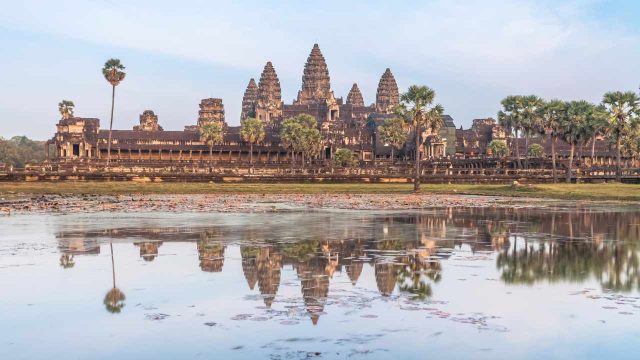
Angkor in the dry season pulls its biggest crowds between mid December and late February, when the air is coolest and tour buses line up before dawn. Hotel rates rise, the reflecting pool at Angkor Wat fills by 5:15 AM, and Ta Prohm’s tree roots get a queue.
Shoulder dates are the wiser bet. Early November, before the full season starts, and the second half of March, after the worst heat but before Khmer New Year in mid April, both give you dry ground with fewer people. Weekdays help as well. Monday to Thursday traffic runs lighter than the weekend.

What Are the Best Morning Routes to Beat Heat and Queues at Angkor Wat?
Start at Angkor Wat for sunrise, then move to Angkor Thom, Bayon and Ta Prohm in that order before the heat builds.
The small circuit ties the well known sites into about 30 km, and it works best run early. Gates open at 5:00 AM and the park closes at 6:30 PM, so the first hour is cool and quiet Angkor Enterprise.
My usual order for a dry season morning:
- Angkor Wat, 5:00 to 7:30 AM. Sunrise over the towers, then the inner galleries while the light is still soft.
- Angkor Thom and Bayon, 7:45 to 9:00 AM. The faces catch morning light, and this area sits in shade longer than most.
- Ta Prohm, 9:15 to 10:30 AM. Many large groups leave Ta Prohm around lunchtime, so a morning arrival means quieter walkways under the silk cotton trees.
- Hotel by 11:00 AM. Rest, then return for a late afternoon temple.
The longer circuit adds Preah Khan, Neak Pean and East Mebon. It suits a second day because the stops spread out and keep you near water and trees, where the air moves. If you want that route handled for you, Angkor Grand Circuit Tour runs it with a driver who times each stop around the heat.
Midday Break Strategy: Where to Go Between 11:30 AM and 2:30 PM
The middle of a dry season day is not wasted time. It is the part that lets you enjoy the evening. Between 11:30 AM and 2:30 PM the light is harsh, the stone is hot, and the temples hold almost no shade.
Three options work.
Hotel and pool. The easiest one. Sleep an hour, swim, eat. You walk into the afternoon temple fresh instead of drained.
Long lunch in town. Cool restaurants in central Siem Reap serve Khmer food and cold drinks, and you get a break from the dust.
Air conditioned car between sites. On a tight schedule, use the vehicle as your rest stop. Cold bottled water waits in the car after every temple, and the air conditioning feels best right after walking through Angkor Thom in the afternoon.
What Should You Wear and Drink at Angkor in the Dry Season?
Wear light long sleeves, a wide brim hat and closed shoes, and drink 1.5 to 2 litres of water per person per half day.
Dress rules are strict at the upper levels of some temples. Shoulders and knees need cover, and a scarf over bare shoulders is often not enough at Angkor Wat’s top terrace. Light long sleeves help in dry season heat. They block sun and cut sweat loss.
Sun protection is not optional. High SPF sunscreen, a wide brim hat and sunglasses cover the basics, with a reapply at the midday break.
Water matters more than most people expect. Drink 1.5 to 2 litres per person for each half day, and more in April. Add electrolytes if you sweat heavily. Watch the ground too. Dry season paths are dustier and harder, with loose grit on the stairs. Closed shoes with grip beat sandals on the steep steps of Ta Keo and the upper levels of Angkor Wat.
How Does Dry Season Light Affect Your Photos?
Dry season gives you open skies, strong shadows and a low sun angle in the morning and late afternoon.
Blue skies are the big gain. From early November to late March the sky opens up often enough that sunrise at Angkor Wat usually delivers colour WeatherSpark. Dust haze can soften distant towers at midday, which is another reason to shoot early and late.
A few things worth watching. Morning light hits the west facade of Angkor Wat, so the classic reflection shot works before 7:00 AM. Bayon’s faces read best in soft side light, so 8:00 AM suits them. Ta Prohm’s tree roots look flat under hard noon sun and rich in the late afternoon. Go for the hour after 3:00 PM, when shadows stretch and the stone warms up.
Sample 1 to 3 Day Dry Season Itineraries for Angkor
Short trips need tight routing, while longer trips can absorb the heat with rest breaks and outlying temples.
One Day: Angkor Wat, Bayon and Ta Prohm
Sunrise at Angkor Wat, then Bayon, then Ta Prohm. Rest from 11:30 AM. Return for sunset at Phnom Bakheng or a quiet stop at Preah Khan. Buy the $37 one day pass Angkor Enterprise.
Two Days: Add the Longer Circuit
Day one follows the small circuit above. Day two takes the longer circuit in the morning, then Banteay Srei in the afternoon if you have transport, or a slow return to the Angkor Wat galleries you missed.
Three Days: Far Temples and a Rest Day
Use the $62 three day pass, valid on any three days inside a one week window Angkor Enterprise. Add the far sites. Koh Ker and Beng Mealea sit about two hours from Siem Reap, and the drive is easier in dry season because the roads are firm. Beng Mealea carries its own $5 ticket. For a guided version, see Koh Ker and Beng Mealea Adventure. Keep the third day light: one morning temple, then a late swim and an evening at the night market.
The 9 Planning Tips at a Glance
- Go November to February for cooler air. March and April are the hottest stretch.
- Start before 5:30 AM and stop by 10:30 AM. Beat the heat and the buses.
- Take a real midday break. 11:30 AM to 2:30 PM in air conditioning or a pool.
- Buy the right pass. $37 for 1 day, $62 for 3 days, $72 for 7 days.
- Pick shoulder dates. Early November and late March are calmer than the January peak.
- Drink 1.5 to 2 litres per half day. Add electrolytes in April.
- Cover up. Light long sleeves, a wide brim hat, high SPF sunscreen.
- Wear closed shoes with grip. Dry ground is dusty and the stairs are uneven.
- Book transport that waits. A driver who holds cold water and shade turns a hard day into an easy one.
Budgets, Passes and Booking
Passes come from Angkor Enterprise, the official seller, and a one day pass is valid on the date you pick. Buy online before you fly in peak weeks. Beng Mealea and Kbal Spean each cost $5 extra, and Koh Ker sits under its own ticket.
Hotels in Siem Reap cover a wide range. Budget rooms start low, mid range hotels with pools sit in a comfortable band, and that pool becomes a planning tool in March and April. Book early for the December to February window.
Why Travelers Hand the Route to a Local Planner
Heat decides what is possible in a day. A route that looks short on a map can turn into a two hour walk in full sun. Local planners in Siem Reap set the day around shade, water and timing, not just distance. That is the quiet reason a private car with a patient driver often costs less than it looks: you see more, and you end the day without a headache. Southeast Asia Journeys plans these days across Cambodia, from Angkor to the far temples. Angkor in the dry season is easier when someone else watches the clock and the water supply.
My Take on Angkor in the Dry Season
I have walked these temples in December mist and in April glare, and dry season is still my pick. Angkor in the dry season hands you dry paths, working sunrises and a park that runs on time. What you give up is comfort at noon, and that is a trade you can handle with two moves: start at dawn, stop at midday.
If you plan one trip this year, do three things. Check the heat month for your dates, buy your pass early from Angkor Enterprise, and arrange a car that waits with cold water. Everything else follows. When you are ready to shape your days around your own dates and pace, send us a message and we will plan the route around the weather instead of against it.