Skip to content
Best Temples in Angkor
Best Temples in Angkor for travelers who want the right mix of famous icons, quieter ruins, and a route that wastes no temple time.
Temple highlights, history and visitor tips.
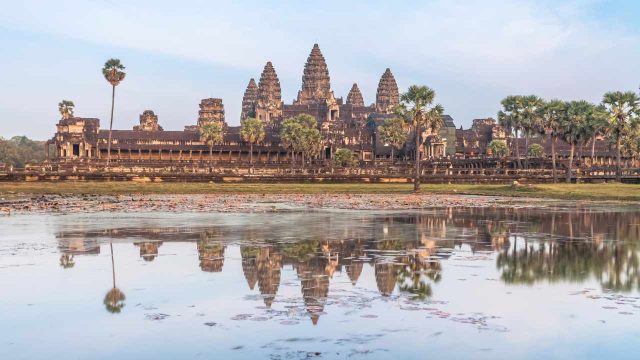
Best Temples in Angkor is not a one-temple story. If you stop at Angkor Wat and head back to town, you miss the stone faces, pink carvings, root-wrapped walls, elephant guardians, and outer-ring ruins that give the whole park its range.
The Best Temples in Angkor are not all on the same mood line, and that is the point. Bayon gives you tight, watchful stone faces inside a walled royal city, Ta Prohm gives you roots and broken halls, Banteay Srei gives you pink sandstone cut with tiny, sharp detail, and Preah Khan gives you long, half-wild corridors that feel far from the busier stops.
Official figures show that Angkor covers about400 square kilometres, so a short list matters if you do not want temple fatigue. If you only have one day, I would not try to “do Angkor.” I would pick a tight route, buy the pass early, dress for the code at the gates, and save room for one quiet ruin that is not on every first draft of a Siem Reap plan.
What to know fast
- The park is huge, with scores of temples, waterworks, roads, and living villages inside the heritage zone, so picking the right stops beats trying to see everything.
- The official Angkor pass prices areUS$37 for 1 day, US$62 for 3 days, and US$72 for 7 days, which makes a 3 day pass the sweet spot for many first trips.
- The visitor code says shoulders must be covered and shorts or skirts above the knee are barred in sacred places, so dress for the gates, not just for the heat.
- If you want a mapped route right away, keep reading into the linked pages for the Grand Circuit, the Rolous and Banteay Srei day, the sunrise route, and the longer Siem Reap plan.
Best Temples in Angkor becomes far easier to plan once you stop thinking in terms of “the temple” and start thinking in terms of contrast. You want one city temple, one root-bound ruin, one fine-carving stop, one high-view pyramid, and at least one quieter site where the day slows down. That mix gives you texture. It also keeps the trip from turning into a blur of sandstone and sweat.
What are the Best Temples in Angkor if you want more than the postcard stop?
Start with the temples that give you the widest spread of style, mood, and history, then add the quieter ruins that match your pace.
I tell friends to rank by feeling as much as fame. A good Angkor day should shift shape as it moves. You want enclosed spaces and open terraces, dark galleries and bright causeways, tight carving and big views. That is what the Best Temples in Angkor list below does.
1. Bayon
Bayon sits inside Angkor Thom, the late 12th-century “Great City” founded by Jayavarman VII and spread across900 hectares, and that setting matters. You are not just walking into a temple. You are walking into the stone center of an old royal capital. I like Bayon early because the faces feel close and calm before the paths get busy. APSARA lists Bayon as a Mahayana Buddhist temple from the late 12th to early 13th century, and the site still feels like a mind at work, full of towers, turns, and sudden views.
2. Ta Prohm
The old name of Ta Prohm was Rajavihara, or “royal monastery,” and APSARA dates its consecration to1186 AD. The outer wall encloses an area aboutone kilometre by seven hundred metres, so this is not a small side stop. The roots and broken stone get the fame, yet what stays with me is the way the halls feel half claimed by the forest and half held in place by human hands. Walk slowly here. The temple rewards small pauses more than quick photos.
3. Banteay Srei
APSARA dates Banteay Srei to 22 April 967, and the site still feels sharp and exact in a way larger temples do not. The pink sandstone and close-cut carving are the draw, but size is part of the charm too. You are not scanning huge walls from a distance. You are moving close to lintels, pediments, and small surfaces that hold their detail. The northbound drive from Siem Reap takes about an hour, which sounds long on paper and feels fair once you arrive.
4. Preah Khan
APSARA describes Preah Khan as “Sacred Sword,” a considerable city and a Buddhist university, and that old scale still comes through. On the Grand Circuit page, the site is described as nearly140 acresof mostly unrestored galleries, and that is why I rate it so high. You can wander here without the pressure to keep up with a queue. Moss, trees, side corridors, and long lines of stone pull you in deeper with each turn. If Bayon feels dense and inward, Preah Khan feels loose and drifting.
5. Pre Rup
APSARA says Pre Rup was consecrated in 961 and notes its pyramidal form with multiple sanctuary levels. This is one of the Best Temples in Angkor for late-day light, not because someone told you sunset is nice, but because the stone itself shifts tone when the sun drops. The Grand Circuit route ends here for a reason. You climb steep steps, reach the upper level, and the flat countryside opens around you. It feels earned.
6. East Mebon
APSARA places East Mebon in the middle of the East Baray, a dry reservoir measuring7.5 km by 1.83 kmand once holding55 million cubic metres of water. That single fact changes how the temple reads. Today it stands in a dry field. In its own day, it rose from water. The life-sized stone elephants on the terraces give it a strong, grounded feel, and kids usually lock onto them right away.
7. Neak Pean
APSARA says Neak Pean was built under Jayavarman VII at the center of the Northern Baray, Jayatataka. The Grand Circuit page explains the temple’s healing-pool idea in plain terms, and that old water logic is part of the pull. You cross a wooden walkway over open water, and the approach itself does half the work. It feels spare, balanced, and unlike the heavier temple-mountain stops.
8. Ta Som
APSARA calls Ta Som a modest complex built under Jayavarman VII and ringed by concentric moats, with carved faces on the east gate. The fig-tree-wrapped gate on the Grand Circuit route is the famous frame, but the temple earns more than a photo stop. It is small enough to read fast and calm enough to leave a mark. On a full temple day, Ta Som often feels like the moment when the pace finally drops.
9. Bakong
APSARA says Bakong was the first real pyramidal temple in Cambodia to take the “temple mountain” form. That alone puts it high on my list for anyone who wants the early Khmer story, not just the late famous stops. The Rolous route links Bakong with Preah Ko and Lolei, and that grouping makes sense. Bakong feels like a turning point in stone. You can see ideas here that later grow much larger at Angkor.
10. Preah Ko
APSARA dates Preah Ko to 25 January 880under King Indravarman I and notes its six towers on a single base. This is one of the oldest stops on this list, and the age comes through in the brick, scale, and low profile. I like Preah Ko because it resets your eye. After larger stone sites, the smaller brick towers and surviving carved work make you pay close attention again.
11. Beng Mealea
APSARA says Beng Mealea was built in the mid 12th century on a layout similar to Angkor Wat and lies about60 kilometres northeast of Siem Reap. It is farther out, rougher at the edges, and less polished as a first-timer stop. That is also why many people remember it so well. The Koh Ker and Beng Mealea day treats it as the quieter answer to the busier headline temples, and I think that is fair.
How should you group the Best Temples in Angkor into real days?
Group by temple type, not by a random map pin list, and the park starts to make sense fast.
This is where many Angkor plans go wrong. People bunch together famous names, not places that fit the same rhythm. The Best Temples in Angkor work far better when each day has a clear shape.
-
One strong day, no 4:30 a.m. start
Open the Angkor Grand Circuit Tour if you want Preah Khan, Neak Pean, Ta Som, East Mebon, and Pre Rup threaded into one outer-loop day. That route gives you range without the sunrise crush, and it avoids the feeling that you spent half your day doubling back. -
One strong day with the dawn photo at Angkor Wat
If sunrise matters to you, the private guided Angkor sunrise tour already pairs Angkor Wat with Bayon, Baphuon, the Terrace of the Elephants, the Terrace of the Leper King, and Ta Prohm. That is a heavy-hitter day. Wear light clothes that still meet the dress code, and keep breakfast and water in mind. -
One full day that mixes sunrise with Banteay Srei
The private sunrise tour to Angkor Wat with Banteay Srei adds Srah Srang, Kbal Spean, and Banteay Srei. It is a long day, yet the order works. You move from dawn crowds to river carvings and then to fine pink stone. -
A second day for early Khmer sites and fine carving
The Rolous Group and Banteay Srei route is the right follow-up when you want Bakong, Preah Ko, Lolei, and Banteay Srei in one line. This is the day for travelers who care about how Angkor started, not just how it peaked. -
Three or four days if you want space in the plan
The 4 day Siem Reap route is the page I would open when you want temple time without rushing every hour. If Beng Mealea and the farther ruins pull you, add the Koh Ker and Beng Mealea day.
If you still feel torn, start at the main Southeast Asia Journeys page. Open two route pages side by side. You will know fast which day feels like your day.
When should you visit the Best Temples in Angkor, and what do you need before the gate?
Buy the pass early, sort your entry paperwork before your flight, and dress for the temple code, not the hotel pool.
The Best Temples in Angkor do not ask for hard planning. They do ask for clean planning. A few small steps save a lot of friction once you are in Siem Reap.
- The official Angkor figures listUS$37 for 1 day, US$62 for 3 days, and US$72 for 7 days, with ticket office hours from5:00 a.m. to 5:30 p.m..
- The visitor code bars bare shoulders and hemlines above the knee in sacred places, and it also warns against touching carvings, climbing loose stones, and bringing sharp-tip umbrellas or tripods inside some temple spaces.
- UNESCO says Angkor contains scores of temples, roads, canals, reservoirs, and living settlements, withmore than 100,000 inhabitants across 112 historic settlements, so this is not a sealed museum zone. It is still lived in. That changes how you should move through it.
- The official Cambodia eVisa site lists Tourist Visa T atUS$30and Business Visa E atUS$35, both with3 month validity,1 month stay, and3 business day processing.
- The same official eVisa page says all travelers should submit the Cambodia e-Arrival within7 days before arrival, so keep both arrival.gov.kh and evisa.gov.kh on your pre-flight list.
A word on timing. Sunrise at Angkor Wat has pull, and I get it. Still, not every day has to start in the dark. Some of the Best Temples in Angkor are stronger when you reach them after the first rush, with your breakfast in you and no panic in the car.
Which pages on Southeast Asia Journeys should you open after this Best Temples in Angkor guide?
Open the page that matches your days first, then move to the contact page once the temple list feels right.
This is the part where the article should stop being a nice read and start doing real work for your trip. The Best Temples in Angkor only matter if they land on a route you will still like at noon.
- Open the Angkor Grand Circuit Tour if Preah Khan, Neak Pean, Ta Som, East Mebon, and Pre Rup are already calling your name.
- Open the Rolous Group and Banteay Srei page if you want early Khmer temples, brick towers, and that pink sandstone stop in one morning-to-lunch line.
- Open the private guided Angkor sunrise tour if Bayon, Ta Prohm, and the dawn photo at Angkor Wat are non-negotiable.
- Open the private sunrise tour to Angkor Wat with Banteay Srei if you want sunrise, Banteay Srei, and Kbal Spean folded into one long temple day.
- Open the 4 day Siem Reap route if you want room to breathe between temple blocks.
- Open the Koh Ker and Beng Mealea day if the farther ruins sound like the part of Cambodia you will talk about longest.
If you are still shaping the order, go straight to the contact page. A short message there will save you from piling too many stone sites into one hot afternoon.
So where would I send a friend after reading about the Best Temples in Angkor?
I would tell them to pick fewer temples, pick better contrasts, and leave space for one site that feels personal.
When I think about the Best Temples in Angkor, I do not think about one sunrise photo and a rushed ride back to town. I think about the shift from Bayon’s close faces to Ta Prohm’s roots, then the small, sharp carvings at Banteay Srei, then the late climb at Pre Rup when the stone goes warm. That mix is why the Best Temples in Angkor still feel fresh, even after endless lists online flatten them into one long blur.
My advice is plain. Pick your number of days first. Buy your pass from the official source. Sort your visa on the official eVisa site, file your Cambodia e-Arrival, and then use the route pages on Southeast Asia Journeys to narrow the list. If you want us to map the order around your hotel, energy, and temple interests, send the note through Connect. Do not stop at the postcard. Give Angkor enough time to surprise you.
Sources
- UNESCO World Heritage Centre, Angkor
- Angkor Enterprise, Visitor Code of Conduct
- Official Cambodia eVisa
- Official Cambodia e-Arrival
- APSARA National Authority, Angkor Thom
- APSARA National Authority, Bayon
- APSARA National Authority, Ta Prohm
- APSARA National Authority, Banteay Srei
- APSARA National Authority, Preah Khan
- APSARA National Authority, Pre Rup
- APSARA National Authority, East Mebon
- APSARA National Authority, Neak Pean
- APSARA National Authority, Ta Som
- APSARA National Authority, Bakong
- APSARA National Authority, Preah Ko
- APSARA National Authority, Beng Mealea
- Southeast Asia Journeys
- Angkor Grand Circuit Tour
- Rolous Group Tour and Banteay Srei Tour
- Private Guided Angkor Sunrise Tour
- Private Sunrise Tour to Angkor Wat with Banteay Srei
- 4 Day Siem Reap Tour
- Koh Ker and Beng Mealea Day Tour