Skip to content
Can You Visit Angkor Wat and Tonle Sap in One Day?
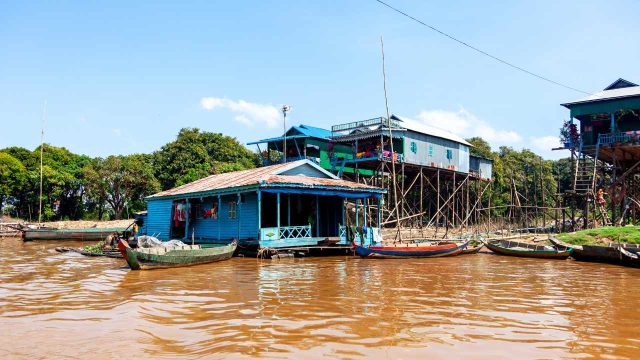
Angkor Wat opens its gates at 5:00 AM, and by mid-afternoon you can be on a boat drifting past stilt houses in a village that floods every single year. The question is whether both fit into one day without wrecking you.
What you will get, what it costs you in time, and who this day actually suits.
- What you will see: sunrise over the towers of Angkor Wat, then a slow boat past stilt houses and flooded forest on Tonle Sap.
- What it costs you in time: a 5:00 AM pickup, 2 to 3 hours inside the temple park, 2 to 3 hours on the water, and 10 to 12 hours door to door.
- Who it suits: travelers with a single spare day in Siem Reap who would rather move fast than fly back a second time.
Yes, you can visit Angkor Wat and Tonle Sap in one day, and thousands of visitors do it every week. The clock decides the whole thing. Leave your hotel between 5:00 and 5:30 AM, give the temples 2 to 3 hours, then ride out to a floating village for a 2 to 3 hour boat trip. Door to door, the day runs 10 to 12 hours. Book your driver and your boat before you land in Siem Reap, because the dock is no place to haggle when your legs are already tired. If you want either stop to feel calm instead of crammed, split them across two mornings.
Quick Facts Before You Read
- Day length: 10 to 12 hours, hotel to hotel, with almost no slack in the middle.
- Park hours: Angkor opens at 5:00 AM and the park closes at 6:30 PM, according to Angkor Enterprise, the official ticket body.
- Angkor pass: 37 US dollars for one day, 62 for three days, 72 for seven days, sold only through the official ticket office.
- Closest lake access: Chong Kneas, about 16 km and 20 minutes from central Siem Reap.
- Middle option: Kompong Phluk, roughly 30 km, or 45 minutes to an hour by car.
- Quietest village: Kampong Khleang, around 50 km and up to 1.5 hours away.
- Boat budgets: 15 to 25 dollars at Chong Kneas, 20 to 35 at Kompong Phluk, 25 to 45 at Kampong Khleang, based on current operator pricing.
- Lake swing: UNESCO records that the Mekong’s overflow can push Tonle Sap to five times its usual size.

Can You Visit Angkor Wat and Tonle Sap in One Day Without Rushing?
Yes, but the day runs long and tightly timed
Yes, and the pacing is kinder than most people fear, as long as the temple stop stays focused. Nearly all the strain lands in the middle hours, when the heat climbs and the transfer to the lake eats an hour or more in each direction.
Look at what dawn actually feels like. At 5:15 AM the ticket booth is lit but quiet, tuk-tuk drivers are nursing iced coffee, and the stone causeway over Angkor Wat’s moat is close to empty. Two hours later that same causeway is a slow parade of lanyards and umbrellas. That gap is the whole argument for starting early.
Here is how a workable day runs.
- 5:00 to 5:30 AM: hotel pickup, ticket check at the gate, walk in for sunrise.
- 5:30 to 7:30 AM: sunrise, then the main temple and one or two galleries.
- 7:30 to 8:15 AM: breakfast near the park, or back at your hotel if it is close.
- 8:30 to 10:00 AM: road transfer toward the lake.
- 10:00 AM to 1:00 PM: boat tour through the village and, in high water, the flooded forest.
- 1:00 to 3:00 PM: lunch near the dock, then the ride home.
- 3:30 to 4:30 PM: back at your hotel, usually before the afternoon heat breaks.
That is the version that works. The version that fails looks like this: you sleep until 7:00, reach Angkor at 8:30, wander three temples until noon, then find out the lake is 50 km away and the last boats leave at 4:00. Plenty of travelers have lived that afternoon. It is not fun.
One tradeoff worth naming: a single-day Angkor pass gives you unlimited re-entry on that date, so nothing stops you from returning to the park at sunset. Just be honest about your energy. Most people who add Tonle Sap to a temple day skip the sunset return, and that is a fine call.
If you would rather have the temples handled properly, with a driver who knows the quiet gates and the cold-water stops, a private guided Angkor sunrise tour removes the two things that break this schedule most often: waiting for tickets and guessing at routes.
What Does Tonle Sap Mean for a One Day Trip: Kompong Phluk or Chong Kneas?
Two villages, two different boat rides
Chong Kneas is the fast, easy, heavily tour-oriented choice, and Kompong Phluk is the calmer middle ground that most first-time visitors end up preferring.
Distance tells you a lot. Chong Kneas sits about 16 km out, so a tuk-tuk can get you there in 20 minutes. Kompong Phluk is roughly 30 km, or 45 minutes to an hour by car. Kampong Khleang is the long haul at around 50 km and up to 1.5 hours, and it is the one most people skip, which is exactly why it stays quiet.
Chong Kneas: closest, busiest
You will reach it fastest, and you will share the water with the most boats. The village has a long, well-documented history of on-site package sales and mid-trip “donation” stops, so a fixed price agreed before you arrive matters here more than anywhere else.
Kompong Phluk: stilts plus flooded forest
This is the village standing on unusually tall stilts at the edge of a flooded mangrove forest. From roughly mid-August through January, small boats slide directly between trees standing in open water, and that short stretch is the single most photographed scene on the lake. Between March and May the forest routes narrow or close, though the stilted village stays visitable.
Kampong Khleang: the working town
Kampong Khleang is the largest of the three, home to around 6,000 residents, and it feels like a real provincial town that happens to stand on timber. Some houses sit on stilts close to 10 metres tall, and in the dry season you can see the full height of them from the road. If you want a Kampong Khleang floating village tour instead of a crowd, this is the one to pick.
For most people on a tight one-day plan, Kompong Phluk is the sweet spot. It is far enough out to filter the heaviest bus traffic, close enough to keep the round trip under control.

How Much Time Do You Need at Angkor Wat for a Combined Day?
Two to three hours inside the park, temple by temple
Two to three hours covers the main temple and one or two secondary stops at a comfortable walk. Anything under 90 minutes means you are jogging past bas-reliefs that deserve a slow look.
Break it down properly.
- Angkor Wat itself: 90 minutes, including the causeway, the outer galleries, and the climb toward the upper terrace.
- Bayon, in Angkor Thom: 30 to 40 minutes for the face towers, plus 10 minutes to reach it.
- Ta Prohm: 30 minutes. Many large groups leave around lunchtime, so the walk between the silk-cotton roots gets noticeably quieter in the early afternoon.
That is a real 2.5 hours before you count walking between parking areas, which is where people lose time. The park holds more than 50 accessible temples, and the honest advice for a combined day is to ignore almost all of them.
Bold call: skip the small circuit. Sunrise at the main temple, Bayon, and Ta Prohm give you the three images you came for, and they leave you enough energy for the boat.
How Long Do You Need on Tonle Sap for a Boat Tour Worth Taking?
Two to three hours on the water, plus the road
The boat itself usually runs 1.5 to 2 hours, and the whole lake half of your day takes 4 to 5 hours once you add the transfer, boarding, and a stop for food. Can you visit Angkor Wat and Tonle Sap in one day and still enjoy both? The boat timing settles that more than the temples do.
Here is where people miscalculate. They budget for the boat and forget everything around it.
- Road time: 45 minutes to 1.5 hours each way, depending on the village.
- Boarding: 15 to 30 minutes, longer if you have not pre-booked.
- On the water: 90 minutes minimum for the village loop, two hours if you include the flooded forest.
- Lunch: 45 minutes at a dock restaurant, and the fried rice tastes nicer than you expect.
Add it up and you are looking at roughly five hours from hotel to hotel for Kompong Phluk. That is why the morning temple block has to stay short. It is also why pre-booking the boat matters so much. Turning up at the launch point at 11:00 AM and negotiating from scratch can cost you an hour you do not have.
A word on cost. The Angkor pass and the boat ticket are separate, so a combined day usually lands between 55 and 90 dollars per person before food and transport. Budget the Angkor ticket and the boat as two line items, not one.
Can You Visit Angkor Wat and Tonle Sap in One Day With Sunrise First?
Sunrise wins, and here is why the order matters
Sunrise first is the right call, and the reason is heat and light rather than romance. The lake boats do not run before dawn anyway, and the temples are at their most forgiving before 9:00 AM.
Flip the order and the day falls apart quietly. A boat at 8:00 AM means you reach Angkor around 1:00 PM, which is the hottest stretch of the afternoon, with hard flat light on the sandstone and tour buses at their peak. You would also be walking the causeway when the shade is thinnest.
There is a second reason. Angkor Wat is the one temple in the park that opens at 5:00 AM so visitors can catch the sun coming up behind the towers. Arrive at the right time and you get that. Arrive at 1:00 PM and you get the same sandstone, only hotter.
So the order is settled: temples at dawn, lake in the late morning, home by late afternoon. A Tonle Sap treasures itinerary slots neatly into that second half if you want the water side arranged for you.
Dry Season or Rainy Season: How Water Levels Shift the Plan?
Low water shortens the route, high water rewrites the scenery
Season steers this day more than any other factor, and it shapes both halves differently. Dry season makes the lake predictable and the forest routes shorter. Rainy season makes the lake dramatic and the rides longer.
The mechanics are worth knowing. Tonle Sap is the largest freshwater lake in Southeast Asia, and UNESCO describes how the Mekong backs up into it each year, expanding it up to five times. At the end of the dry season the lake can sit around one metre of water in places, which is why some channels turn to mud.
Tonle Sap water levels in the dry season
Roughly November through April. Water drops, routes shorten, and Chong Kneas boats sometimes cover half the distance they cover in October. Kompong Phluk’s flooded-forest lanes narrow from February and often close by March. What you gain is stable weather, dry roads, and easier temple mornings.
Tonle Sap water levels in the rainy season
Roughly August through November. The lake swells, the flooded forest fills, and boats push through trees instead of around them. Rides run longer and the scenery is the postcard version. Afternoon storms can roll in fast, and a small boat on open water gets choppy, so a morning slot is safer.
If your dates can move and the flooded forest is the thing you came for, go for September or October. If you want dry roads and easy temple light, come between December and February.
Can You Visit Angkor Wat and Tonle Sap in One Day If You Hate Packed Schedules?
Then split it into two days and keep both visits calm
So, can you visit Angkor Wat and Tonle Sap in one day and still enjoy it? Yes. Should you? That is a different question. Then split it, and stop apologizing for it. Two unhurried mornings beat one frantic one, and the cost difference is smaller than you would guess.
Think about what a split actually buys you. On day one you take the sunrise tour, stay for Bayon and Ta Prohm, and still have the afternoon free for the pool. On day two you leave at 8:00 AM for the lake, spend three hours on the water, and eat lunch at the dock without checking your watch. Nobody is sprinting to a boat.
The numbers hold up too. A three-day Angkor pass costs 62 dollars, against 37 for one day, so the upgrade is 25 dollars. A half-day lake tour runs roughly 35 to 45 dollars. You are spending a little more and getting two calm days out of it.
There is a third option worth knowing about. If your Siem Reap stop is short and you only have one morning, pick one anchor and treat the other as a bonus. Sunrise at the temples, then a late lunch in town, is a perfectly good day. Nobody flies home wishing they had spent more time in a minibus.
Where to Start Planning
So, can you visit Angkor Wat and Tonle Sap in one day? Yes, with an early start and a boat booked before you fly. Here is the plain version. One day works, and it works best when you start at dawn and pre-book everything. Two days run calmer, and they cost about 25 dollars more on the temple side.
Three things to do this week:
- Check your travel month against the water-level guidance above and decide whether the flooded forest matters to you.
- Book the temple half first, since sunrise slots and good drivers fill up before the boats do.
- Confirm the boat price in writing, including the full route, before you leave your hotel.
Start with the Southeast Asia Journeys homepage to see how the days are put together, and browse the full sitemap if you want to compare every route side by side.
A Last Word on the Clock
I have watched people try to cram Angkor Wat and Tonle Sap into one day, and I have watched people do it well. The ones who enjoy it are never the ones who slept in. They are the ones who accepted a 5:00 AM alarm, kept the temple block tight, and let the lake be the reward rather than the rush. Can you visit Angkor Wat and Tonle Sap in one day? You can, and on the right schedule it is one of the most complete days Cambodia offers. Ask yourself honestly whether you want to cover both places or actually see them, then pick the version that matches your answer. If you want a day planned around your dates, your water levels, and your energy, send us a message and we will map it out before you book a single ticket.