Skip to content

Ethical Floating Village Tourism: Proven Ways to Avoid Mistakes in 2026 and 2027 on Tonle Sap
The best souvenir you can carry home from Tonle Sap is the feeling that nobody performed for you.
See how a respectful day on the water actually works: what your boat money pays for, when to lift a camera, why candy hurts, and which village fits your trip.
Ethical floating village tourism gets easy once you treat the lake as a neighborhood, not a show. Pick a village where families live year round, pay the official ticket price, ask before every photo, and skip the orphanage stops and candy handouts that harm while they look kind. Wet months, June to October, turn the lake into a wide brown sea; dry months bare the ten meter stilts and the mud paths. Water has run low for several years now, so ask about levels before you book. Go with a licensed local guide, eat lunch in the village, and your money lands where your memories come from.
Need-to-Know Before You Book
- Ask before every photo, and take a shake of the head as final.
- Hand nothing to children. Buy fruit from the family stall beside them instead.
- Skip orphanage visits and orphanage donations. More than 80 percent of children in Cambodia’s residential care have at least one living parent.
- Pay printed prices; Angkor Enterprise sells the official Chong Kneas boat ticket alongside the Angkor Pass.
- Match the village to your day. Kampong Khleang sits about 55 kilometers out and rewards a full day; Chong Khneas fills a spare hour.
- Watch the water report, not the weather forecast. Levels set the trip more than clouds do.
Ethical floating village tourism means your boat money reaches fishing families, your camera follows the village’s own courtesy rules, and your day bends around how people on Tonle Sap live. Below: the etiquette that matters, what a respectful day costs, where the money should go, how to visit Tonle Sap respectfully whichever dock you pick, and how to pick between a short cruise and a full private day.

Ethical Floating Village Tourism in Practice: What Your Money, Photos, and Minutes Do
Ethical floating village tourism starts with scale. The lake covers about 2,500 square kilometers in the dry months and spreads past 12,000 at flood height, according to OSMOSE, a group that runs conservation work on the water. UNESCO counts the lake among the top four fishery production areas in the world. Inland fish supply more than 70 percent of the protein Cambodians eat, with a usual catch near 500,000 tonnes in good years. You are not visiting a sideshow. You are drifting through the national pantry.
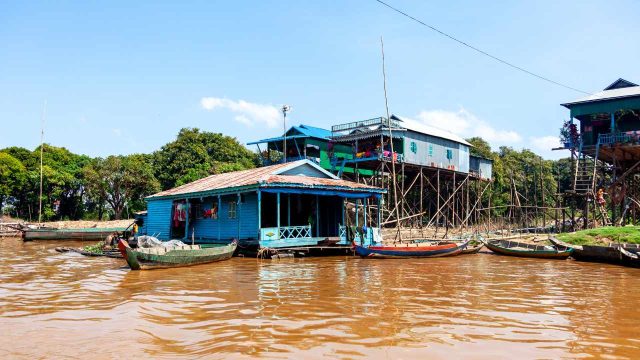
Who calls the lake home? Khmer, Vietnamese, and Cham Muslim families, the mix UNESCO lists for the reserve, plus 225 bird species, 17 of them endangered worldwide. Some houses ride on barrels and bamboo rafts and slide around the lake with the seasons. Others stand on stilts and wait for the water to climb to them. Kampong Khleang does both, which is one reason I send people there. The other reason shows up at lunch: grilled fish at a stilt-house table beats any hotel buffet.
Is It Okay to Point a Camera at People on the Water?
Ask with a gesture, wait for a nod, and keep a long zoom for working boats. If someone says no, lower the camera and go buy breakfast next door.
Photography here runs on privacy rules the village sets, not you. Morning markets, net mending, and boats stacked with ice make honest pictures from a distance. Bath spots, laundry lines, and prayer time belong to the family alone. A camera aimed at a school needs the teacher’s blessing first.
My five habits after many lake mornings:
- Point at your camera, raise an eyebrow, wait. A nod is a yes, and a shake is final.
- Shoot wide from the boat. Save close-ups for people who wave first.
- Never pay a child to pose. ChildSafe’s traveler tips tie paying kids to keeping them out of school.
- Offer to send copies through your guide; a grandmother’s print request from my last trip was posted the following week.
- Put the camera down for one stretch of the ride. The best frame is often the one your eyes keep.

What Do You Do When Children Ask for Money or Candy?
Give nothing to children directly. Buy snacks from the adults beside them, pass supplies to a school through a guide, and leave orphanage tours off the plan.
A small hand at the boat rail feels hard to refuse. ChildSafe’s seven tips for travelers ask visitors to skip both begging handouts and purchases from children, because both pull kids toward work on the water and away from class. Sweets rot teeth that village clinics rarely fix, and each plastic wrapper ends up in the lake you came to admire. Money that follows fruit, grilled fish, or a family’s coffee pot feeds children and parents together.
Orphanage tourism deserves its own line. UNICEF reports that more than 80 percent of children in Cambodia’s care homes have at least one living parent, which turns most visits into theater with children in the cast. ChildSafe says it flatly: children are not tourist attractions. If a cause moves you, fund a program that keeps families together, and ask your guide which ones work near the lake.
Does Ethical Floating Village Tourism Cost More Than a Cheap Boat Seat?
A little more, and most of the gap lands in the village. The cheapest seat at the nearest dock pays a ticket window first and a family last, if at all.
Ethical floating village tourism is not the cheap seat; it is the fair one. Follow a dollar for a second. At Chong Khneas, the boat ticket is now official: Angkor Enterprise, the desk that sells the Angkor Pass, is also the official seller of the Chong Kneas boat ticket, so printed prices replace dockside haggling. Farther out, no such desk exists, and who you book with decides where the money sits. A shared seat keeps costs low and crowds high. A private day with a licensed guide and a pre-booked boat trades cash for calm, and lunch in the village moves another slice of your budget onto stilt-house tables.
Time is the other price. Kampong Khleang sits about 55 kilometers east of Siem Reap, and the drive eats most of two hours each way. If your schedule holds one morning, pick the nearest stilt village and go early. If you have a full day, distance becomes your friend and the tour buses stay behind.

Which Village Deserves Your Day?
Ethical floating village tourism is mostly about picking the right dock before you book; the rest follows.
Chong Khneas
Closest to town, about 15 kilometers south of Siem Reap, and the most toured. The fish market has real bite, yet the village has taken the hardest hit: floating houses spent July 2026 grounded on dry banks because the water never arrived. Go only if the clock leaves you no other choice.
Kampong Phluk
The easy half day: stilt houses, a flooded forest, canoe lanes in high water. Pretty in late afternoon light, and busy with group tours.
Kampong Khleang
The one I plan most. The largest stilted and floating village on the lake, home to roughly 1,800 families, with stilts standing six to ten meters tall. You walk the dry-season lanes, ride past floating gardens in wet months, and eat where fishermen eat. Distance keeps the bus tours away.
Want the full route with a kralan stop and a market walk laid out hour by hour? Our Kampong Khleang Floating Village Tour page lists the whole day, and Tonle Sap Treasures shows how the lake pairs with temple mornings.
When Should You Go, and What Is the Water Doing Lately?
High water, June to October, turns lanes into canals. Dry season, November to May, exposes the stilts. Lately the wet season itself has run late and weak.
The lake runs on a pulse: each wet season the Mekong pushes water back up the Tonle Sap river, and that reverse flow can stretch the lake to five times its dry-season size. In 2026 the pulse stuttered. The reversal started about six weeks late and ran at 4 billion cubic meters against an 11 billion average, according to the Stimson Center’s Mekong Dam Monitor. Researchers from the Cambodia Development Resource Institute and Royal University of Phnom Penh counted a 50 percent drop in fish production between 2018 and 2020, from 291,260 to 144,635 tonnes. Fishers told Mekong Independent in July 2026 that some floating houses no longer float at all.
Ethical floating village tourism in a low-water year asks a bit more of you. Book with someone who checks conditions that week, because a grounded house turns a photo stop into something sadder. Then spend where it counts: buy the grilled fish, hire the village boat man, tip the guide who translates. Respect, this year, looks a lot like a fair day’s wage.
Ethical Floating Village Tourism: A Last Word From the Water
I keep a soft spot for ethical floating village tourism because it fixed my own worst travel habit: showing up, taking, leaving. The lake taught me to ask first, pay fair, and treat a fisher’s commute like my own. That is the whole trick of ethical floating village tourism: plan the respect before the boat leaves the dock.
Three steps get you there. Pick your village and season first. Book a licensed guide with a pre-booked boat, and carry small riel bills for market buys. Then browse southeastasiajourneys.com to plan the days around the lake, and when you want a hand with timing and tickets, send us a note through our connect page. We answer with a plan, not a brochure.
Sources
- UNESCO, Tonle Sap Biosphere Reserve
- OSMOSE, The Tonle Sap Great Lake
- Mekong Independent, Floating Houses Stuck Aground (August 2026)
- UNICEF Cambodia, Caring for Children Left Behind in Residential Care
- Angkor Enterprise, Official Angkor Pass and Chong Kneas Boat Ticket
- Southeast Asia Journeys, Kampong Khleang Floating Village Tour
- Southeast Asia Journeys, Tonle Sap Treasures