Skip to content

Kampong Phluk in Wet and Dry Seasons
See the Stilts or Sail the Treetops: What Each Season Gives You, What It Costs You in Time, and Who Should Go
The boatman at Kampong Phluk does not check the date. He looks up at the trees. When the crowns of the flooded forest sit level with his gunwale, the lake is full and he can cut straight through the trunks. When those same trees stand on dry, cracked mud, he knows the channel will be narrow and the ride short.
That one difference is what Kampong Phluk in Wet and Dry Seasons comes down to. It decides how far the boat goes, whether the houses look like they float or like they are standing on very tall legs, and what time of day you should aim for.
Kampong Phluk in Wet and Dry Seasons works like two different villages on the same patch of floodplain. From about August to early November the Tonle Sap fills, the boat crosses the flooded forest itself, and the stilt houses sit so low that the poles vanish. From December to May the water pulls back, the poles stand bare above mud, and you climb down a long staircase to reach a smaller boat. Neither version is the real one. What changes is the route, the view and how much of the village you can see.
Key takeaways
- Wet season shows the forest. Dry season shows the houses. Kampong Phluk in Wet and Dry Seasons gives you one or the other, rarely both.
- Water depth sets the route. Deep water means a longer ride across open water. Low water means a tighter channel and a walk down to the boat.
- March and April expose the most stilt. The lake is at its thinnest and the poles look almost comically tall.
- Late November and May are the compromise. Enough water for a smooth ride, enough exposure to understand how the village is built.
Quick facts before you read on
Kampong Phluk in Wet and Dry Seasons, in numbers.
- Lake depth: about 0.5 m in the dry months and up to 9 m at the peak of the flood, based on WCS Cambodia habitat surveys of the lake.
- Lake size: the surface spreads from roughly 2,500 square kilometres to between 10,000 and 16,000 when the Mekong reverses into it.

What Kampong Phluk in Wet and Dry Seasons Actually Changes on the Water
The Tonle Sap runs backwards for part of the year. For most months the Tonle Sap River drains it into the Mekong. Then the monsoon swells the Mekong from June onward, the current stalls, turns, and pushes water back up into the lake. Its surface area jumps from about 2,500 square kilometres to somewhere between 10,000 and 16,000, and UNESCO records the overflow as able to expand the lake by up to five times its dry season size.
Kampong Phluk sits inside that floodplain, a short drive southeast of Siem Reap, in a cluster of hamlets where almost every house stands on wooden poles. Those poles are cut to the height of the worst flood, not an average Tuesday, which is why one house reads as a normal stilt home in February and a floating cabin in September.
| What you notice | Wet season, about August to early November | Dry season, about December to May |
|---|---|---|
| Water under the boat | Deep, open lake at the end of the ride | Shallow channel, sometimes barely a boat length wide |
| Boat route | Through flooded forest, then open water | Shorter run, smaller boat, more turns |
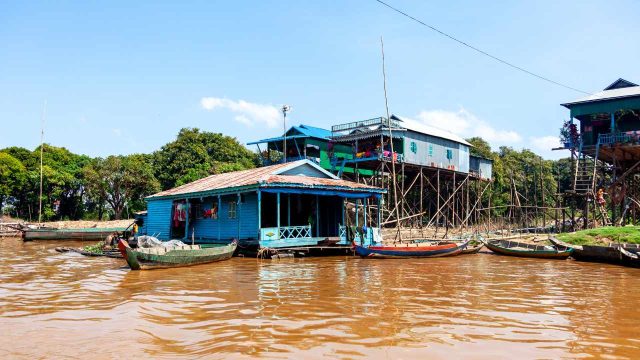
| Stilt houses | Water near the floorboards, poles hidden | Poles fully exposed, staircases in the air |
| Flooded forest | Trunks submerged, canopy at eye level | Dry trunks, cracked mud, roots showing |
The table is tidy. Reality is messier, since a weak monsoon can push the water weeks later than the chart suggests. Treat any month by month guide, including this one, as a pattern rather than a promise.
How Deep Is the Water at Kampong Phluk in the Wet Season?
Deep enough that the boat leaves the channel and crosses the forest itself
By late September the water sits several metres above the dry season bed, and the driver stops following a marked line. He cuts between tree trunks instead. Branches that would be at chest height in April pass over your head. Leaves brush the roof of the boat. The water is brown green and fully opaque, so there is no reflection until you clear the forest and reach open lake.
The strangest part is what disappears. In October you will not see a single pole. The houses appear to float, exactly as most photographs promise, which means the engineering that makes the village interesting is hidden below your feet.
High water brings more boats, since this is the version most listings sell, plus mosquitoes at dusk and an engine pushing through stems where the canopy closes in.
What Does the Dry Season Reveal That the Wet Season Hides?
Low water turns the village inside out
From about February the floodplain drains, the poles come out of the water, and Kampong Phluk stops looking like a floating settlement and starts looking like a very tall wooden town built on a mudflat. Ladders appear, and so do staircases that end eight or nine metres above the ground, because that is where the front doors are.
The boat changes as well. Instead of crossing open water you follow a narrow channel, sometimes so shallow that the propeller has to be lifted and the driver poles through the last stretch. Boatmen switch to smaller hulls and trim the route. What you lose in distance you gain in detail: laundry lines, stacked fish traps, a dog asleep in the shade of a pole, kids cycling on ground that was lake bed four months earlier.
March and April: the clearest view of the poles
This is the driest stretch, and the one I would pick if the village matters more than the forest. Heat is the price. Afternoons push past 35 degrees Celsius, the mud dries pale and cracked, and the light gets hard by mid morning. Go early. The boat is quieter at 7am and the poles throw long shadows across the flats.
December and January: water still high, poles just showing
The first metre or so of pole appears around the new year, and the forest stays green enough to feel alive. This is the easiest month for anyone travelling with children. Levels are forgiving, crowds are thinner than in October, and you get a partial view of both versions of the village.
Which Season Works Better for Kampong Phluk in Wet and Dry Seasons?
Match the month to the photograph you actually want
Start with the image in your head and work backwards. A boat sliding between submerged trees, with a house that seems to float, belongs to September. A wall of wooden legs under a tin roof belongs to February. Once you know which of those you came for, the calendar answers itself.
- You want the flooded forest and an open water sunset. Aim for September or early October. Expect more boats and a wetter, greener, slightly chaotic ride.
- You want to see how the village is built. Aim for February or March. Expect heat, dust, and the best photographs of the poles.
- You have one free afternoon and no strong preference. Aim for late November or May. You get a smooth route, half exposed poles, and far less company.
My own bias: the shoulder months are underrated. November gives you water high enough for the long route, with poles already showing at the base. It is not the postcard, which is exactly why I like it.
How Do You Plan the Day So Kampong Phluk in Wet and Dry Seasons Works for You?
Build the trip around light and level, not just the month
Mornings are flat and quiet, which suits the flooded forest. Afternoons bring wind across the open lake and a better chance of sunset, which suits the wet season. In low water the timing matters less, since the channel is shaded and the ride is short.
The official Angkor pass covers the temples and not the lake, so the boat is a separate arrangement. The drive from Siem Reap takes under an hour, so a lake trip fits into half a day and leaves room for a temple morning.
If you would rather not solve boat logistics at the dock, our Tonle Sap Treasures fishing village and flooded forest trip runs the boat with a local crew and times departure to whatever the water is doing that week. Longer stays fit a lake day into the seven day Cambodia route and the five day Siem Reap itinerary, with room to move it if the level shifts. You can hold a date on the booking page and adjust it later.
What Do Most Visitors Get Wrong About Kampong Phluk in Wet and Dry Seasons?
It is not a floating village, and the forest is not always flooded
The label does the damage. Kampong Phluk is a stilt village on a floodplain, not a settlement of houses bobbing on pontoons, and only the boats truly float there all year. Visitors who arrive in March expecting to drift past front doors sometimes feel cheated. They are standing under the same houses, just at a different water line.
The second misunderstanding is about scale. This is a working fishing community inside a reserve that produces an estimated 180,000 to 250,000 tonnes of fish a year across the lake, with at least 149 recorded species. It is not a set built for tourists.
Which leads to one small opinion. Ask before you photograph people on their own stairs, and skip the school if you are only there for a picture. Nobody in the village needs another bag of sweets handed out from a boat.
A Last Word on Kampong Phluk in Wet and Dry Seasons
I have taken people out in both versions of this place, and the ones who enjoy it most are rarely the ones with the best camera. They are the ones who decided in advance what they wanted to see. Kampong Phluk in Wet and Dry Seasons rewards that small piece of planning more than any line about the best time to go.
So here is what I would actually do. Pick your month from the two lists above rather than from a discount. Ask what the water is doing the week you travel, not the season, because a late monsoon can shift everything by a month. Give the lake half a day so a slow channel does not eat your temple morning. Then let the boatman read the trees.
Send us your dates on the contact page and we will tell you honestly whether your week is a forest week or a stilt week. Browse the rest of the Southeast Asia Journeys site while you wait.
The water will do what it has always done. Your only job is to arrive in the month that shows you the village you came for.
Sources and references
- WCS Cambodia: Tonle Sap Lake floodplain, species and habitats
- UNESCO: Tonle Sap Biosphere Reserve
- Angkor Enterprise: official Angkor pass and ticket site
- Southeast Asia Journeys: Tonle Sap Treasures tour
- Southeast Asia Journeys: Cambodia 7 day tour
- Southeast Asia Journeys: 5 days in Siem Reap itinerary