Skip to content
Phnom Kulen Beng Mealea tour from Siem Reap hotel
What you will swim in, do, and see on a single 11.5 hour day out of your hotel: a jungle waterfall, a monk blessing on Cambodia’s most sacred mountain, and an unrestored temple. This is how the day runs, what the tickets cost, and exactly who should book it.
Six calm stops, one private car, your own guide, and a 7:30pm hotel return. Skip the 4am alarm entirely.
Ask ten travelers about a Phnom Kulen Beng Mealea tour from Siem Reap hotel and half will tell you it needs a pre-dawn start. They are wrong. You climb into the car at 8am, swim under a jungle waterfall before lunch, collect a blessing from a monk on Cambodia’s most sacred mountain, and finish inside a temple the forest has been claiming for 800 years.
My team has run Cambodia tours since 2003, and the Phnom Kulen Beng Mealea tour from Siem Reap hotel is the day people still talk about at dinner years later. It works like this: a private car, an English-speaking guide, and a pace you set. You watch palm sugar boil in a village, swim under the falls, take a monk blessing, and walk the overgrown halls of Beng Mealea. You leave at 8am and step back into your hotel lobby by 7:30pm, as the day tour page spells out.
Main Points at a Glance
The Phnom Kulen Beng Mealea tour from Siem Reap hotel pairs a sacred mountain with an unrestored ruin in one calm day.
- Leave at 8am, home by 7:30pm. No 4am alarm, no sunrise rush.
- A 50 km drive north to Phnom Kulen, which peaks at 487 m, per the tour page.
- A monk blessing beside the largest reclining Buddha in Cambodia, carved into living rock.
- Beng Mealea, raised around the same time as Angkor Wat, roughly 40 km east of the city, per the tour page.
- Entry tickets bought at each gate. The Angkor pass does not cover either site, per the tour page.
- Cold water, cool towels, and charging ports ride with you in the car.

What does the Phnom Kulen Beng Mealea tour from Siem Reap hotel include?
Seven stops fold into one day, all of it in a private air-conditioned vehicle with your own driver and an English-speaking guide. Pickup is free inside Siem Reap town, per the tour page.
The day moves in seven calm blocks. Your guide phones the lobby between 8:00 and 8:15, and the car arrives between 7:50 and 8:20. The guide wears a green Southeast Asia Journeys shirt, so the handshake in the lobby is easy to spot. You toss a towel, swimsuit, sunscreen, and water bottle into the vehicle and ride 30 minutes north through sugar palms to Preah Dak village. Stays outside town carry a small pickup fee, confirmed in writing before you book.
At a family cafe run here for three generations, women boil palm sap in an open iron pot until it turns into sticky dark sugar. You taste warm palm cake on fresh sticky rice while 60 to 100 kids at the local primary school wait for the five boxes of sweets you carry in, a detail straight from the day tour page. They shout awkun, which is Khmer for thank you.
The road climbs for an hour into Phnom Kulen National Park. Wild monkeys watch from the roadside, orchids hang off tree limbs, and your guide points out where the Khmer Rouge held a last base in 1979. At the gate you buy your own entry ticket, and that money goes to park rangers and road repair, not to a middleman. Three viewpoints show the falls from different rocks before you drop into the swim pool under the main waterfall, where local families share the water with you. Lunch follows at a family-run restaurant on the mountain, with an a la carte menu of chicken amok, fish curry, fried rice, and fruit shakes, plus vegetarian plates on request.
Why does this Phnom Kulen Beng Mealea tour from Siem Reap hotel start at 8am instead of before dawn?
Because the sunrise dash belongs to Angkor Wat, and this day points north at something older: a sacred mountain, a swim, a blessing, and a ruin nobody tidied up.
Phnom Kulen sits about 50 km north of Siem Reap and peaks at 487 m. In 802 AD, King Jayavarman II was crowned here and declared independence from Java, as the tour page describes. That ceremony starts the Khmer empire, the same one that later raised Angkor Wat.
Why this matters
Without the history, this stop reads as a pretty waterfall. With it, the waterfall marks the birthplace of Cambodia’s greatest empire.
At the summit, Preah Ang Thom houses a reclining Buddha cut straight into a sandstone boulder, the largest of its kind in Cambodia. You climb the lion stairs to the pagoda, where a monk in saffron ties a white string around your wrist, sprinkles holy water over your head, and chants a short Pali prayer for safe travels. A small donation is built in. Add more if you wish.
Starting at 8am gives the day a calm spine. The blocks carry buffer time, so nobody is chased out of the water because a bus is due. You stay in the pool until you are ready to leave. That matters more than it sounds after an hour in the sun.

What do the gate fees and paperwork look like on a Phnom Kulen Beng Mealea tour from Siem Reap hotel?
The tour price covers the private car, your driver, your guide, and the small blessing donation, per the tour page. The Angkor pass does not cover Kulen or Beng Mealea. Each site sells its own ticket at its own gate office.
Paperwork comes first, because that is what travelers forget. Cambodia issues an official e-visa: USD 30 for a tourist visa, usually approved within 3 business days, valid for 3 months, with a stay of up to 1 month on a single entry, all listed on the e-visa portal. It works at Siem Reap Angkor International Airport and at the new Techo airport near Phnom Penh. Mind the land borders. The e-visa is accepted at Bavet and Tropaeng Kreal, while Poipet and Cham Yeam are closed to e-visa entry until further notice.
Why the e-Arrival exists
The visa says you may enter. The e-Arrival card tells border officers who you are and where you will sleep. Every traveler must fill in the e-Arrival even with a visa already approved, and the government recommends sending it within 7 days before landing so the immigration queue stays short, per the e-visa portal.
If Angkor Wat is also on your list, that pass sells separately at official windows: USD 37 for 1 day, USD 62 for 3 days, and USD 72 for 7 days, with ticket offices open from 5:00am to 5:30pm, figures published on the e-visa portal. Most visitors take the 3-day pass when they also want Bayon and Ta Prohm, then keep this mountain route as its own day.
Then come the two gates on the route. At Phnom Kulen you pay at the national park gate. At Beng Mealea the ticket office sits about 1 km before the temple, per the tour page. The van stops, you handle the ticket, and the driver rolls on to the real entrance. Both purchases take minutes. Prices and rules were checked in August 2026.
Pack for the water: swimsuit, towel, sunscreen, a dry shirt for the ride home, and sandals that grip wet rock. The vehicle carries cold water anyway, and the driver keeps a cold towel folded for the last stretch.
Who should take this day, and who should choose a different plan?
Travelers who want the whole Kulen story without the dawn rush. Families with kids, older walkers, swimmers, and anyone tired of being counted in and out of a group coach.
Here is the honest trade. If your one wish in Cambodia is sunrise over Angkor Wat’s towers, book that as its own morning and let this day sit elsewhere on your calendar. If you measure a holiday by temples per hour, this is not that day. It is one mountain, one ruin, and one night market, done without rushing.
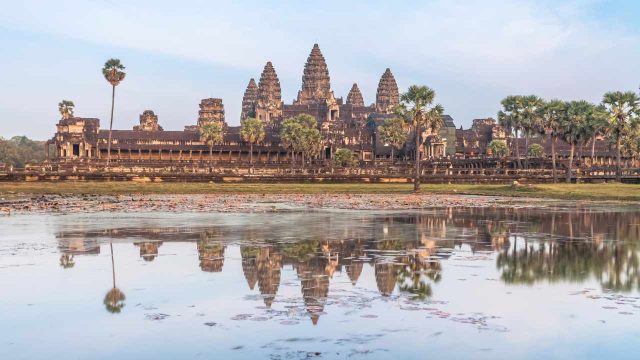
Beng Mealea lies about 40 km east of Siem Reap and was raised in the same style and roughly the same period as Angkor Wat. Restoration never came for this temple, so the forest had centuries to win the argument. Trees break through the roofs. Roots crawl over carved faces. Stone blocks sit where they dropped eight hundred years ago. A raised wooden walkway, built by a French survey team in 2010, carries you through without stepping on the ruin, as described on the tour page. Look for the crocodile tree, its trunk curling out of the inner sanctuary. No ropes. No queues. In the late afternoon the soft light turns the moss a dark green, and the only sounds are birds and dripping water.
Why this matters
Angkor Wat is the polished showpiece. Beng Mealea is the same story left unfinished, and that unfinished state is exactly why photographers and plant lovers prefer it.
For travelers who fit that mood, the Phnom Kulen Beng Mealea tour from Siem Reap hotel lands right. The cross-country road takes 40 quiet minutes, past lotus ponds and water buffalo, instead of main highway traffic. On a shared coach, your time at each stop runs to a printed clock: so many minutes at the falls, everyone back on board. Here the buffer is yours. Nobody counts heads twice. Your vehicle stops when you spot something worth a photo.
The day closes at Street 60 market on National Road 6, where the grills light up around 5pm. Sugar cane juice, mango sticky rice, grilled skewers, and the occasional plate of fried crickets fill the stalls. You get about 30 minutes there, per the tour page, before the van carries you the last stretch home. Want to skip the market and get back earlier? Tell your guide. The route bends.
Where the Day Leaves You
I keep a small mental shelf of traveler moments, and the one that repeats most often is 7:30pm at the van door, sun still on people’s faces, someone holding up a phone to show the white string on their wrist. That is the memory most people carry out of the Phnom Kulen Beng Mealea tour from Siem Reap hotel. I have watched this route since 2003, and for most visitors I still rate a Kulen swim over an Angkor sunrise. The Phnom Kulen Beng Mealea tour from Siem Reap hotel is not about crossing ruins off a list. It is about the ten minutes you float in cold mountain water and the white string still on your wrist at dinner.
Put the day together like this:
- Sort the e-visa at the official portal and allow 3 business days for approval.
- Fill in the e-Arrival card within 7 days of landing.
- Tell the team which hotel you are at and which date you want, then read the tour page so the day surprises no one.
- Send questions through the contact page and get a written confirmation before you arrive.
The mountain keeps its own clock. Come at 8am, and for one day yours matches it.